A garage door can consider anywhere from 130 pounds for a standard solitary steel door to more than 300 pounds for an insulated dual door, and personalized wood doors can climb up much higher. The factor that a lot weight really feels manageable when you lift the door by hand, or when a garage door opener increases it with a moderate electric motor, boils down to something: springtime tension.
When a springtime breaks, the whole system reveals itself simultaneously. The opener stress. The door jerks, stalls, or bangs shut. House owners typically think the issue is the opener since that is the visible machine in the center of the ceiling. In technique, the opener is usually simply the first part to grumble. The actual issue is usually at the spring assembly.
Garage door springtime substitute is just one of those repair work that looks less complex from the driveway than it is up close. I have actually seen doors that were one poor cycle far from coming off track, openers with removed equipments due to the fact that a person maintained attempting to compel a broken springtime door to run, and replacement work complicated by earlier shortcuts, incorrect springtime sizing, or mismatched hardware. Understanding the difference in between torsion and expansion springtimes assists you make better choices, whether you are arranging domestic garage door repair, evaluating a quote, or attempting to comprehend why one repair work expenses more than another.
Why the springs matter greater than many people realize
Springs are the counterbalance system for the entire door. They keep energy when the door shuts and launch it when the door opens up. Without them, the opener would require to lift the full dead weight of the door on every cycle, and the majority of openers are not created for that. Their work is to assist and move a properly balanced door, not work as a crane.
A healthy garage door must remain nearly in place when raised midway by hand. If it races downward, feels uncommonly heavy, or wanders upward by itself, spring tension is likely off. That does not always imply a spring has actually broken. Springs additionally compromise with time. Steel exhaustions. The door might still move, yet the equilibrium factor modifications. That progressive loss of performance is easy to miss till the day the springtime ultimately gives out.
This is where garage door repair comes to be much less concerning a solitary broken component and more about system health and wellness. Springs influence wires, rollers, hinges, track placement, and opener life. When the door runs out balance, those parts bring tension they were never ever meant to absorb.
Torsion springtimes and expansion springtimes are built for the same task, but they do it really differently
Most modern-day garage doors use a couple of spring systems. Both counterbalance the door, but the way they save and deliver power is totally different.
Torsion springs place on a steel shaft above the garage door opening. As the door shuts, the springs wind tighter, storing rotational power. When the door opens up, that energy takes a break with cord drums at each end of the shaft, lifting the door in a regulated way.
Extension springtimes extend along the straight tracks on either side of the garage. As the door shuts, they lengthen and keep energy in stress. When the door opens, they contract and assist draw the door up through a pulley and cable television arrangement.
That standard design distinction affects every little thing else, consisting of life-span, level of smoothness, sound, service complexity, and safety.
Torsion springtimes: the criterion for a lot of modern systems
If you look above your garage door and see a steel tube or shaft with 1 or 2 tightly wound springs around it, you have a torsion system. This is now the liked arrangement for a lot of brand-new garage door installation job, specifically on sectional household doors and numerous business doors.
Torsion springs supply smoother, a lot more controlled motion than expansion springtimes. The lifting force is distributed with the shaft and drums, which often tends to lower door sway and track anxiety. On larger double doors, that security matters. A door that rises evenly lasts longer and positions less strain on the opener.
They additionally tend to supply much better longevity when effectively sized. A standard torsion springtime could be ranked around 10,000 cycles, with one cycle being a full open and close. Higher-cycle alternatives, usually 20,000 cycles or even more, are readily available and worth thinking about for households where the garage serves as the main entryway. In lots of homes, the front door gets much less usage than the garage. Four to 6 cycles a day accumulates quicker than individuals think.
From a solution perspective, torsion systems are a lot more accurate. That is both a benefit and a danger. The springtime size must match the door weight, height, drum dimension, and track setup. Proper winding needs specialized bars, accurate turn matters, and attention to shaft positioning, cable television tension, and set screw placement. An excellent professional can call in the equilibrium wonderfully. An untrained individual can develop an unsafe problem in minutes.
Extension springs: still usual, however less forgiving
Extension springtime systems are typically located on older household doors, lighter doors, and budget-conscious installments. Rather than placing above the header, they run parallel to the horizontal tracks. When they damage, the failing is usually evident. A spring might hang loose, the door may become unequal, or one side may quit raising altogether.
These systems can work well when kept correctly, but they are generally noisier and much less refined than torsion configurations. Because the springtimes stretch and contract along the tracks, they can contribute to much more visible movement and vibration. Pulleys, sheaves, security wires, and hook add-ons all play a role, which means there are much more wear indicate inspect.
One vital information with expansion springs is the safety and security cord. This cable goes through the center of the springtime and assists include it if the springtime breaks. On older doors, I still sometimes see extension springtimes without safety and security cords, and that is a major issue. A damaged expansion spring without a safety cord can whip with pressure, destructive autos, drywall, kept products, or even worse, hurting somebody nearby.
Extension systems are occasionally less expensive to change initially, however they frequently demand closer focus to surrounding equipment. Used sheaves and torn cords prevail companions to a worn out expansion springtime. Replacing only the spring and disregarding those components can turn an economical repair service into a repeat solution call.
How to tell which kind you have
The simplest way to determine the system is by location. Torsion springtimes sit directly over the door opening on a shaft. Extension springs sit next to the upper horizontal tracks, one on each side.
If the door has a solitary long springtime installed flat over the facility of the door, that might be an older torque or specialty arrangement instead of a conventional torsion setting up. Those systems exist, though they are much less usual. In those cases, accurate recognition matters since replacement components are not constantly interchangeable with current typical hardware.
For both homeowners and property managers, excellent photos help when requiring garage door repair. A façade of the entire door, a shot of the springtime area, and close-ups of any kind of damaged or hanging parts can save time and protect against misdiagnosis.
What spring failure looks like in the actual world
A busted torsion springtime frequently reveals itself with a sharp bang, audible that people mistake it for something falling in the garage. The sound comes from the unexpected release of saved energy as the coil divides. If you evaluate the springtime, you will generally see a noticeable space in the coil, frequently two inches or more.
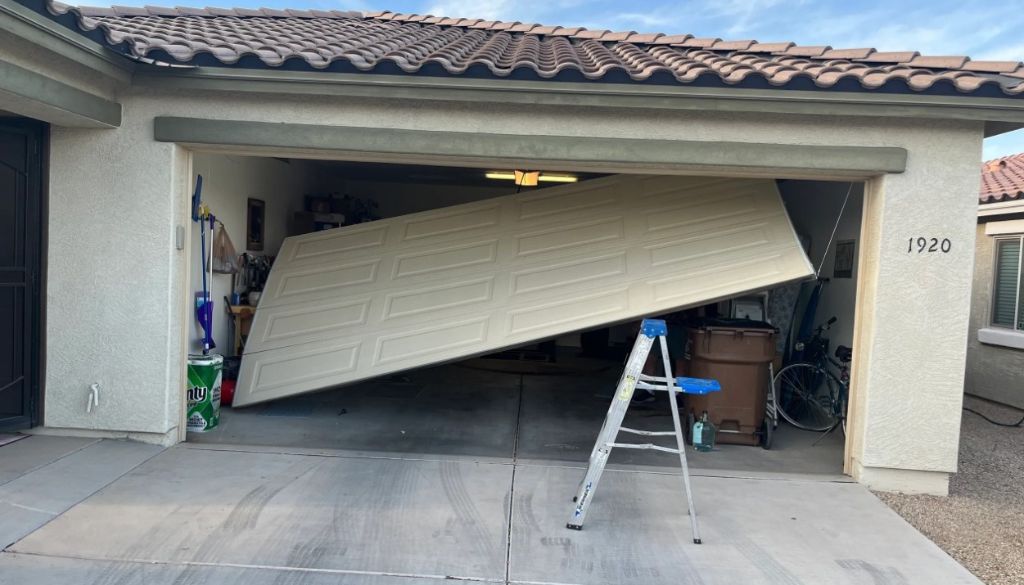
With expansion springtimes, the indicators can be messier. One side of the door may raise while the various other drags. The door may jam at an angle. A cord might come off the pulley. Sometimes, the springtime itself is noticeably lengthened or separated.
Not every failing spring breaks cleanly all at once. Some weaken progressively. The opener might reverse since it senses excess pressure. The door might garage door installation Southport think twice a foot off the floor, which is a typical stress factor because that is where the spring system has to do the most raising job. Property owners sometimes try to solve that by changing opener pressure settings, yet that deals with the signs and symptom as opposed to the cause.
A garage door opener must never be made use of to make up for a falling short springtime. That is how carts bend, equipments strip, and travel limitations obtain tossed off.
Why springtime substitute is hardly ever a do it yourself job
There are home repairs where patience and a good video tutorial can take you far. Garage door spring replacement is not one of them.
The problem is kept power. Springs hold sufficient pressure to raise a heavy door consistently. Releasing or applying that pressure without the right devices and strategy can create extreme injury. Torsion springs are specifically unrelenting due to the fact that winding bars can slip, cones can split, shafts can spin all of a sudden, and set screws can seize or fall short. Expansion systems carry various threats, particularly when cords and sheaves are under tension.
There is likewise the concern of sizing. Springs are not one-size-fits-all. Two doors that look almost the same from the street might call for really different springs depending on door weight, insulation, window areas, track distance, drum size, and headroom. Installing the incorrect spring can leave the door also hefty, as well light, or irregular via its travel.
The threats that make DIY substitute an inadequate idea are relatively consistent:
Professional service technicians do more than swap springtimes. They weigh or compute the door, match the cycle score, evaluate the shaft or track system, validate cable condition, oil moving parts where ideal, and examination equilibrium manually before reconnecting the opener. That sequence matters.
Why both springtimes are usually changed together
On two-spring torsion systems, homeowners commonly ask whether they can replace only the damaged spring and leave the other one alone. Technically, yes. Practically, it is normally a false economy.
If one springtime has actually gotten to completion of its cycle life, the various other springtime has likely been through the same number of cycles. Also if it has not broken yet, it is typically close. Replacing only one spring can also develop inequality if the remaining springtime has actually tired out and shed some initial force.
The exact same logic puts on paired extension springs. Matching lift on both sides of the door is important. A fresh spring on one side and a tired spring on the other side can create uneven traveling, cord problems, and track stress.
There are exceptions. On a newer door where one spring was damaged too soon by rust or a manufacturing defect, replacing one may be affordable. On older systems, combined replacement is generally the smarter service decision.
The repair work discussion ought to include cycle life, not just price
Spring quotes can vary commonly, and a lot of that difference comes down to material quality, cycle score, and whether the price quote consists of related solution work. A reduced number is not constantly a much better worth if it acquires a standard spring that will certainly be tired once more in a couple of years.
For a family that uses the garage as the bottom line of access, an upgrade from a 10,000-cycle springtime to a 20,000-cycle spring frequently makes sense. If the door operates 6 times a day, 10,000 cycles can be exhausted in under 5 years. At 4 cycles a day, it lasts much longer, however still not for life. A higher-cycle spring may cost even more upfront and conserve cash in avoided repeat calls.
This issues for business garage door repair too, though the mathematics obtains much more severe. A service bay door, loading dock door, or auto parking framework door can log hefty everyday use. In those settings, springtime choice is tied straight to downtime threat. One bad failure can disrupt operations, delay deliveries, or create a safety issue for employees.
What a good springtime substitute visit ought to include
When an experienced professional manages garage door spring substitute, the visit needs to cover more than the evident damaged part. Great leaves the entire door running far better than it did before the failing, not just practical enough to close.
A thorough check out frequently consists of the following:
|Service component|Why it matters||-- |--|| Spring sizing verification|Avoids underpowered or crowded out equilibrium|| Cable and drum or pulley assessment|Discovers fraying, misalignment, and wear triggered by spring failing|| Bearing and bracket check|Validates the shaft or track hardware can handle fresh springtime tension|| Door balance test|Makes certain the opener is not raising a hefty or runaway door|| Opener reconnection and safety and security test|Verifies reversal system and travel after the door is well balanced|
That is the distinction between a real repair and a narrow parts swap. If the door equilibrium is not inspected by hand prior to the opener is returned right into solution, the job is incomplete.
Torsion versus expansion in day-to-day use
Homeowners deciding in between fixing and innovation often ask whether they must transform an older expansion system to torsion. Often the solution is indeed, often it is not worth the expense.
Torsion systems generally use smoother traveling, much better control, and easier accuracy tuning. They are frequently the better lasting setup, specifically for heavier shielded doors or double-width doors. They also tend to combine perfectly with quieter modern-day openers due to the fact that the general movement is extra stable.
Extension systems can still execute adequately on lighter doors when all parts remain in good condition. If the tracks are aligned, the sheaves are audio, and safety and security cable televisions are installed, an extension system might continue serving well. The decision depends upon the age of the door, the problem of the equipment, and whether the consumer intends to purchase a more comprehensive upgrade.
I have seen older extension setups that were kept correctly and ran much better than overlooked torsion systems. The equipment type matters, however handiwork and upkeep matter just as much.
The opener is not the celebrity of this repair service, yet it often obtains dragged into it
It is common for individuals to call regarding a garage door opener due to the fact that the remote still works, the motor hums, and the door does stagnate. That sign typically traces back to the spring system. If the spring is broken, the opener may try to lift a door that has instantly become far larger than expected.
Some opener versions will certainly quit and reverse. Others will grind, pressure, or relocate the door a few inches before giving up. On chain-drive devices, you might see the rail bending under tons. On screw-drive or belt-drive systems, the carriage can stall or disconnect.
After springtime replacement, the opener ought to be reconsidered for pressure settings, traveling restrictions, and arm add-on problem. If the door was run consistently with a broken spring, the opener may currently have damages. I have replaced a lot of springs just to uncover the client additionally needed an equipment set or a complete opener replacement due to the fact that the maker had actually been compelled too many times.
That crossover is one factor incorporated solution issues. The best garage door repair service technicians take a look at the entire setting up, not just the failed spring.
Residential and commercial doors require various judgment
Residential garage door repair often centers on comfort, security, and sound. Households desire a door that opens up efficiently, seals properly, and does not wake the house during early separations. Springtime sizing because atmosphere is influenced by insulation, ornamental equipment, wind-rated support, and use habits.
Commercial garage door repair moves the concerns. Cycle quantity, uptime, and equipment longevity transfer to the front. Doors are usually bigger, larger, or exposed to harder conditions. Moving steel doors, sectional expenses doors in warehouses, and full-view light weight aluminum doors in solution bays all put various needs on their springtime systems.
That implies substitute choices can not be replicated over from a residence to a store or filling area. A spring that is great for a rural two-car garage might be entirely incorrect for a business application with regular procedure and higher liability.
Maintenance that assists springtimes last longer
No springtime lasts for life, however a couple of behaviors can maintain the remainder of the system from accelerating its decline. Normal aesthetic assessment assists catch fraying cords, curved hinges, loosened brackets, or pulley wear before they create a bigger failing. Lubricating steel rollers, hinges, and torsion springtimes with an ideal garage door lubricating substance can decrease sound and surface area deterioration, though lubrication is not an alternative to correct balance.
The most valuable point a house owner can do is take note of adjustments. If the door appears harsher than it did last month, really feels larger by hand, or starts stopping in weird locations, that is worth a service call. Springs rarely fall short without a little warning somewhere in the system.
For residential property supervisors taking care of several doors, keeping solution dates and springtime cycle ratings on documents makes intending simpler. Preventative replacement is often more affordable than emergency after-hours fixing, particularly on doors that safeguard inventory or vehicles.
When replacement becomes a bigger conversation
Sometimes a spring failing is just a springtime failing. Various other times, it subjects a bigger concern. A door may be undersized for the opening, the track might be fatigued, or the whole configuration may be overdue for innovation. If the door is older, badly protected, or loud enough to disrupt neighboring rooms, spring replacement can be the moment to discuss a broader garage door setup upgrade.
That does not mean every busted springtime needs to trigger a sales pitch. Often, a tidy spring substitute is the best call. However when the panel areas are rusted, the equipment is used throughout, and the opener is near completion of its life, covering one part at a time ends up being expensive.
An excellent service technician ought to be able to discuss the alternatives clearly: repair what exists, transform the springtime system if advantageous, or change the door bundle if the economics aim that way. Clear judgment matters more than hostile recommendations.
What homeowners need to keep in mind when the springtime breaks
If the door instantly will closed, resist the urge to maintain striking the remote. Separating the opener and trying to raise the door manually can likewise be high-risk if the door is huge or the spring is fully damaged. The most safe action is to quit making use of the door, keep individuals free from it, and call for service.
If the only automobile is entraped within, tell the repair business that when scheduling. Some situations can be prioritized, and some doors can be opened up carefully by experienced service technicians even with a failed springtime, depending on size, damage, and access. What should not occur is a property owner improvisating with clamps, pry bars, or brute force.
Garage door spring substitute is not attractive, but it is one of one of the most consequential repair work in the entire door system. Torsion and extension springs may work in a different way, but both are entitled to regard. When they are sized appropriately, installed correctly, and supported by sound equipment, the door feels virtually lightweight. When they fail, every weak point in the system turns up fast.
That is why understanding the springtime type on your door issues. It aids you ask far better inquiries, spot weak guidance, and select fixings that secure the door, the opener, and individuals that use it every day.